Getting Alarm 13 (A13) on your Danfoss VLT drive? Learn the common causes of overcurrent, how to perform a mechanical check, and steps to verify motor compatibility.
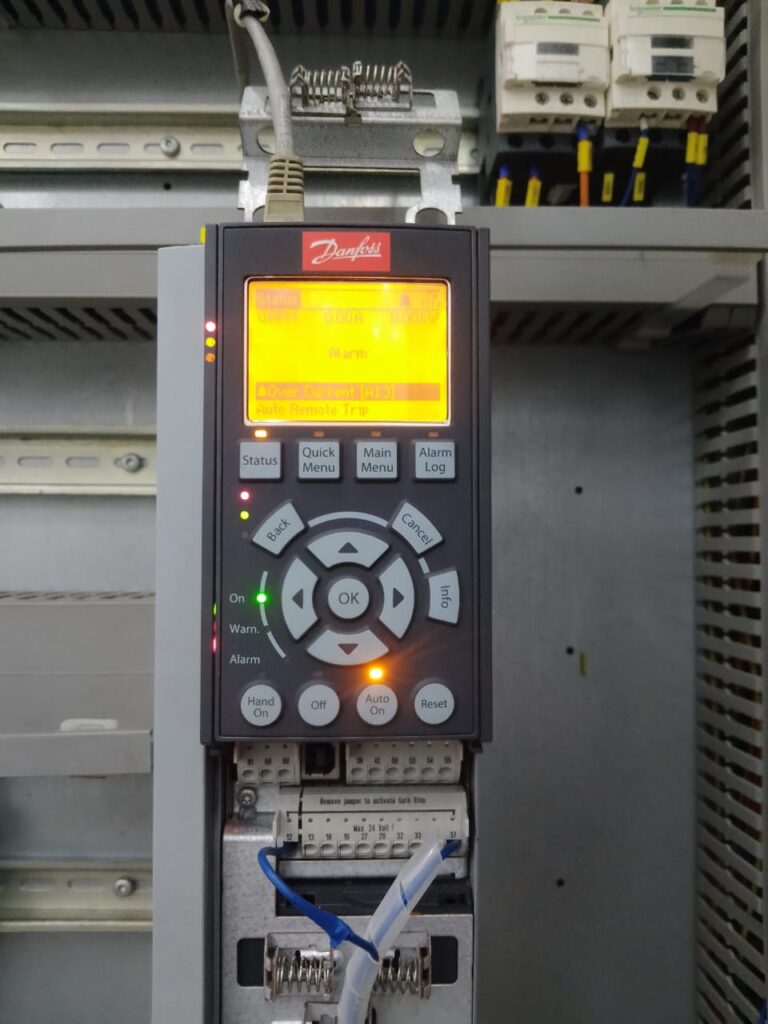
If your Danfoss VLT drive (such as the FC-102, FC-202, or FC-302) has suddenly stopped and the display is flashing Alarm 13, you are dealing with a critical electrical event. This fault, labeled as Overcurrent, is the drive’s primary defense against hardware destruction.
In simple terms, the inverter’s peak current limit has been exceeded. The drive has sensed a surge of electricity so high that it had to shut down in microseconds to prevent the internal IGBTs (transistors) from exploding. Here is a human-made, step-by-step guide to finding the root cause and getting your motor back in motion.
What Triggers Alarm 13?
Alarm 13 occurs when the instantaneous current reaches the hardware’s absolute limit. Unlike a “Motor Overload” (which happens slowly over time), an Overcurrent trip is a “hard” trip. The most common reasons include:
- Mechanical Blockage: The motor shaft is physically unable to turn.
- Electrical Short Circuit: A short in the motor windings or the cables.
- Aggressive Ramps: The acceleration time is set too short for a heavy load.
- Sizing Mismatch: The motor is too large for the VFD’s capacity.
Safety First: VFDs contain high-voltage DC capacitors. Always disconnect the main power and wait at least 15 minutes for the charge to dissipate before touching any motor wiring or drive terminals.
Step-by-Step Troubleshooting Guide
1. The Mechanical “Spin Test”
The first step in the official Danfoss remedy is checking the “iron.” If the motor cannot turn, it will draw “locked rotor” current, which triggers Alarm 13 instantly.
- Action: Switch off the drive and follow LOTO procedures.
- Check: Try to turn the motor shaft by hand (or with a wrench if it’s a large motor).
- Result: If the shaft is seized, check for a jammed pump, a broken gearbox, or a stuck brake. If it spins freely, move to the electrical checks.
2. Verify Motor and Drive Sizing
Is the motor too big for the drive? If you are commissioning a new system, this is a common mistake.
- Action: Check the motor nameplate Amps (FLA) against the drive’s rated output current.
- The Rule: The drive’s output current rating must be equal to or higher than the motor’s rated current. If the motor is significantly larger, the drive will hit its peak limit almost immediately upon starting.
3. Check the “Copper” (Wiring and Insulation)
A short circuit is the most dangerous cause of Alarm 13.
- Terminations: Ensure all connections at the drive terminals (U, V, W) and the motor junction box are tight. Loose strands can cause arcing.
- Megger Test: Disconnect the motor leads from the drive and use an insulation tester (Megger) to check for shorts between phases and from each phase to ground. Never Megger the drive itself!
4. Review Ramps and Parameters
If the mechanics and wiring are healthy, the issue might be in the “Brain.”
- Acceleration Time: If the load has high inertia (like a large fan), a 3-second ramp-up might be too fast. Increase Parameter 3-41 (Acceleration Time) to 15 or 20 seconds and try again.
- Motor Data: Ensure Parameter Group 1-** accurately reflects the motor nameplate (Voltage, Frequency, and Amps).
5. The Isolation Test (Rule out the VFD)
If you still can’t find the problem, determine if the drive is internally damaged:
- Disconnect the motor cables from the bottom of the Danfoss drive.
- Attempt to start the drive without the motor connected.
- If Alarm 13 still occurs: The internal power module (IGBT) of the VFD is shorted. The drive must be repaired or replaced.
- If the drive runs fine: The problem is definitely in your motor, cables, or mechanical load.
Summary Checklist
| Checkpoint | Desired Result |
|---|---|
| Motor Shaft | Must rotate freely by hand. |
| Motor Amps | Must be ≤ Drive Output Amps. |
| Insulation | High resistance (>100 MΩ) to ground. |
| Ramp Time | Long enough to avoid current spikes during start. |