Discover the 4 main types of feeders used in electrical distribution—Radial, Parallel, Ring Main, and Interconnected systems. Learn their pros, cons, and applications.
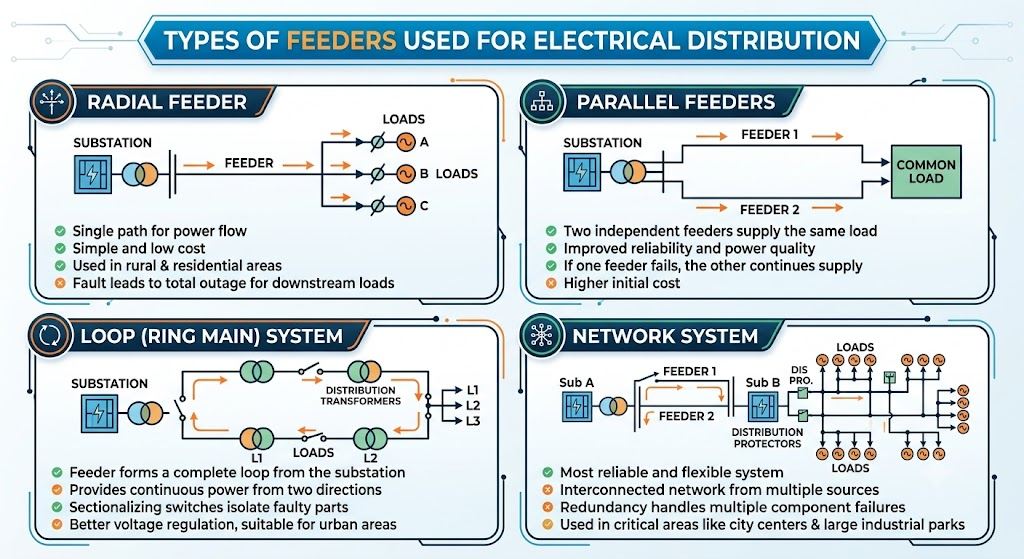
Types of Feeders Used for Electrical Distribution: A Detailed Overview
In an electrical power system, the feeder plays a critical role in the distribution network. It is the power line that transmits electricity from the generating station or a primary substation to the distribution points (distributors) without any intermediate tapping. Because there are no tappings, the current remains constant throughout the length of the feeder.
Choosing the right feeder configuration is essential for ensuring power reliability, reducing voltage drops, and managing costs. Here are the four primary types of feeders used in electrical distribution systems today.
1. Radial Feeder System
The radial feeder is the simplest and most common type of distribution system. In this arrangement, a single feeder radiates from a single substation and feeds several distributors at one end. The power flow is strictly in one direction.
Advantages:
- Low Initial Cost: It is the cheapest system to build and maintain.
- Simplicity: The design and protection systems are easy to implement.
Disadvantages:
- Low Reliability: If a fault occurs anywhere on the feeder, the entire supply to all downstream consumers is interrupted.
- Voltage Fluctuations: The end of the feeder often experiences higher voltage drops during peak loads.
2. Parallel Feeder System
To overcome the reliability issues of the radial system, two or more feeders are run in parallel from the same substation to the load point. These feeders are often interconnected through tie-switches.
Advantages:
- Improved Reliability: If one feeder develops a fault, the other(s) can continue to supply the load.
- Load Sharing: It is ideal for heavy loads where a single cable might not be sufficient.
Disadvantages:
- Higher Cost: Doubling the number of feeders significantly increases the capital investment.
- Complex Protection: Requires more sophisticated switchgear and relays.
3. Ring Main Feeder System
In a ring main system, the feeder forms a closed loop. It starts from the substation busbars, circles the area to be served, and returns to the same substation. Each distribution transformer is connected to two different paths of the ring.
Advantages:
- High Continuity: If a fault occurs on any section of the ring, that section can be isolated, and power can still reach consumers from the other side of the loop.
- Better Voltage Stability: Because power is fed from two directions, voltage fluctuations are minimized.
- Copper Savings: Often uses less conductor material compared to parallel systems for the same reliability.
Disadvantages:
- Design Complexity: The design and installation are more difficult than radial systems.
4. Interconnected Feeder System
An interconnected system (or meshed system) is a ring main feeder that is fed by two or more different substations or generating sources. This is common in large urban areas and high-voltage transmission networks.
Advantages:
- Maximum Reliability: Even if one substation fails completely, the feeders can still receive power from other connected substations.
- Efficiency: Redundant links ensure the system can handle peak loads with minimal losses.
Disadvantages:
- High Complexity and Cost: This is the most expensive and technically demanding configuration to manage.
Conclusion
The choice between Radial, Parallel, Ring Main, or Interconnected feeders depends on the specific requirements of the area. Radial systems are perfect for rural or low-budget projects, while Ring Main and Interconnected systems are the gold standard for modern cities and industrial zones where downtime is not an option.

