Data Acquisition Systems (DAQ) Explained – Curious about how computers measure the real world? Learn exactly what a Data Acquisition System (DAQ) is, how it works, and why it’s essential in modern tech.
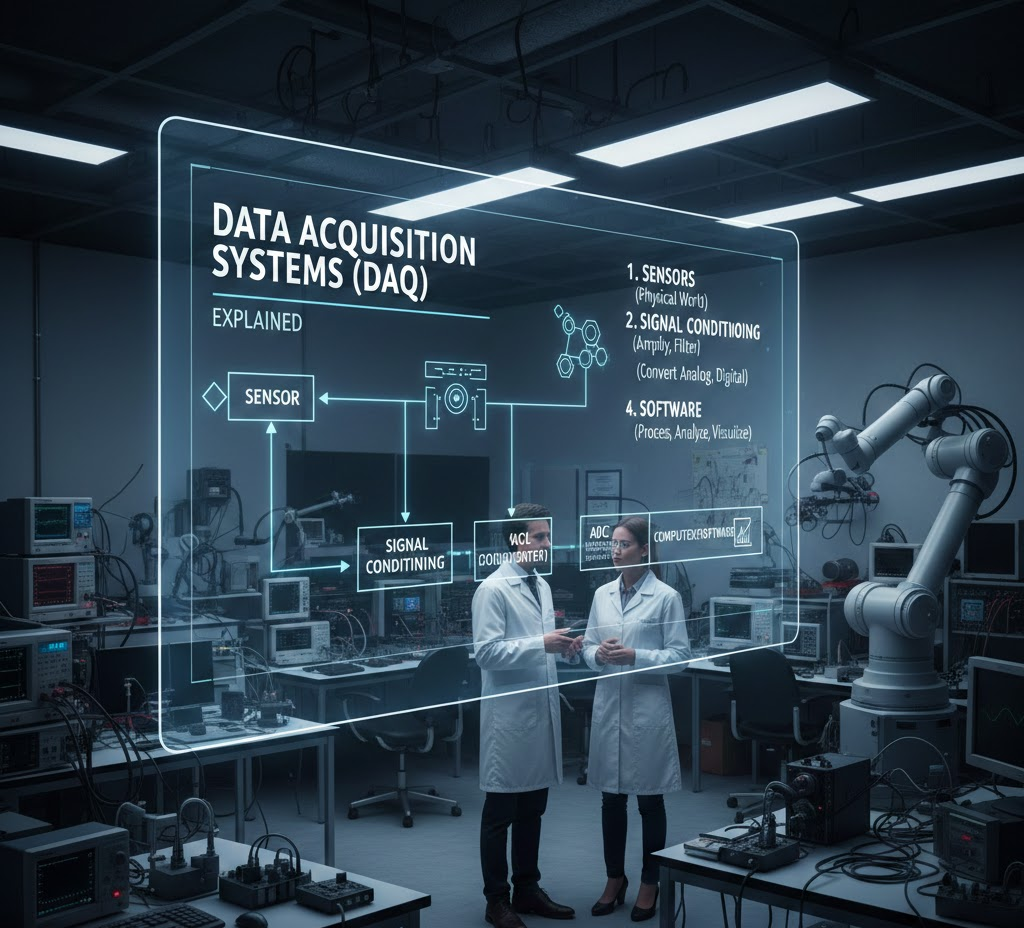
Data Acquisition Systems (DAQ) Explained: The Ultimate Guide
Imagine you are driving a modern car. You glance at the dashboard and see your speed, engine temperature, and fuel level. How does the car know all that?
It’s not magic—it’s a Data Acquisition System.
Whether you are an engineering student, a tech hobbyist, or an industrial manager looking to upgrade your facility, understanding how we capture data from the physical world is crucial.
In this guide, we’re going to break down exactly what a Data Acquisition System (DAQ) is, the components that make it tick, and why it is the backbone of modern innovation.
What is a Data Acquisition System?
At its simplest, a Data Acquisition System (often abbreviated as DAQ or DAS) is a collection of software and hardware that allows you to measure or control physical characteristics of the real world.
Think of a DAQ system as a bridge.
On one side of the bridge, you have the physical world full of analog signals: temperature, sound, vibration, pressure, and light. On the other side, you have a computer that only understands digital binary code (1s and 0s).
The DAQ system grabs that physical information, cleans it up, translates it, and sends it to the computer for analysis.
The 3 Pillars of a DAQ System
You can’t just plug a thermometer into a USB port (usually). A robust Data Acquisition System relies on three specific stages to get the job done.
1. Sensors (The “Feelers”)
Everything starts here. Sensors, also known as transducers, are the eyes and ears of the system. They interact with the physical environment and turn physical properties into electrical signals.
- Thermocouples measure temperature.
- Accelerometers measure vibration or motion.
- Strain gauges measure force.
2. Signal Conditioning (The “Cleaner”)
Raw signals from sensors are often messy. They might be too noisy, too weak, or dangerous to the computer. Signal conditioning circuitry fixes this.
- Amplification: Boosts a weak signal so the computer can read it.
- Filtering: Removes unwanted noise (like the 60Hz hum from power lines).
- Isolation: Protects the expensive computer hardware from high-voltage spikes.
3. Analog-to-Digital Converter (The “Translator”)
This is the heart of the DAQ hardware. The Analog-to-Digital Converter (ADC) takes that conditioned electrical wave and chops it up into digital bits that a computer processor can understand. The higher the quality of the ADC, the more accurate your data will be.
Why Do We Need DAQ Systems?
You might be thinking, “Can’t I just look at a thermometer and write the number down?”
For simple tasks, sure. But in the professional world, manual recording is impossible. Here is why DAQ is vital:
- Speed: Some events happen in microseconds (like a car crash test). No human can write that fast, but a DAQ system can record millions of data points per second.
- Accuracy: Computers don’t make rounding errors or get tired after an 8-hour shift.
- Automation: A DAQ system can trigger alarms automatically. For example, if a factory machine overheats, the system detects it instantly and shuts the machine down to prevent a fire.
Real-World Applications
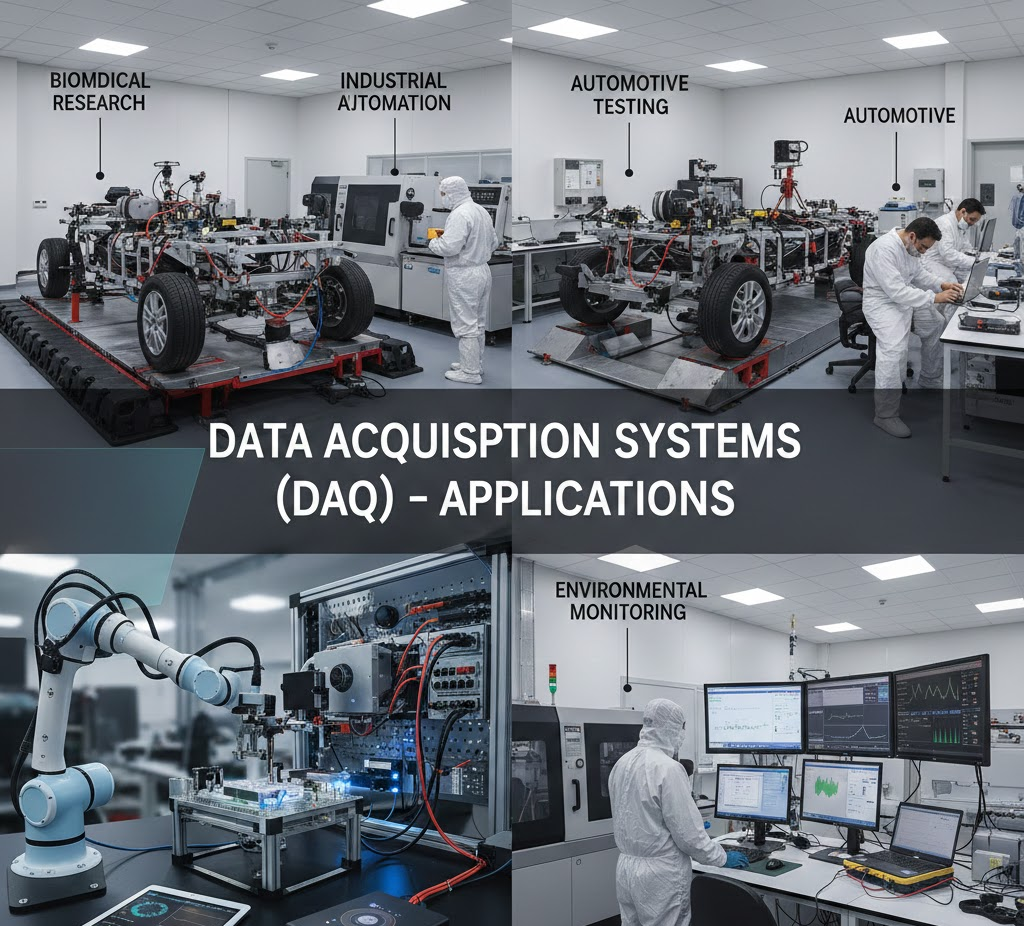
Data acquisition isn’t just for laboratories; it is everywhere.
- Aerospace: Engineers use DAQ to monitor stress on airplane wings during flight testing.
- Manufacturing: Factories use it for quality control, measuring the precise dimensions of parts as they move on a conveyor belt.
- Green Energy: Solar farms use DAQ to monitor sunlight intensity and adjust the angle of panels for maximum efficiency.
How to Choose the Right DAQ System
If you are looking to invest in a system, don’t just buy the most expensive one. Ask yourself these three questions:
- What am I measuring? (Temperature requires different hardware than high-speed vibration).
- How fast does it change? (If you are measuring daily weather, you don’t need a system that captures 100,000 samples per second).
- Where will it be used? (A system in a clean lab doesn’t need to be as rugged as a system used in a dusty mine).
Final Thoughts
We live in a data-driven world. From the smartphone in your pocket to the power plant lighting your home, Data Acquisition Systems are the unsung heroes making it all possible.
By bridging the gap between the physical and digital worlds, DAQ empowers engineers and scientists to make smarter decisions, build safer products, and discover new technologies.