Quickly convert temperature from Kelvin (K) to Celsius (°C). Free online calculator with the conversion formula, reference table, and absolute zero facts.
Kelvin to Celsius (°C to K) Converter
Celsius to Kelvin (°C to K) Converter
The Kelvin to Celsius Conversion Formula
Converting temperature from Kelvin (K) to Celsius (°C) is a straightforward subtraction. Unlike Fahrenheit, the Kelvin and Celsius scales use the exact same temperature increments (a change of 1 Kelvin is exactly equal to a change of 1 degree Celsius). The only difference between the two scales is their starting points.
The calculation formula:
°C = K - 273.15
How to Calculate:
Simply take your temperature in Kelvin and subtract 273.15. For example, if you have a temperature of 300 K, the calculation is 300 - 273.15 = 26.85 °C.
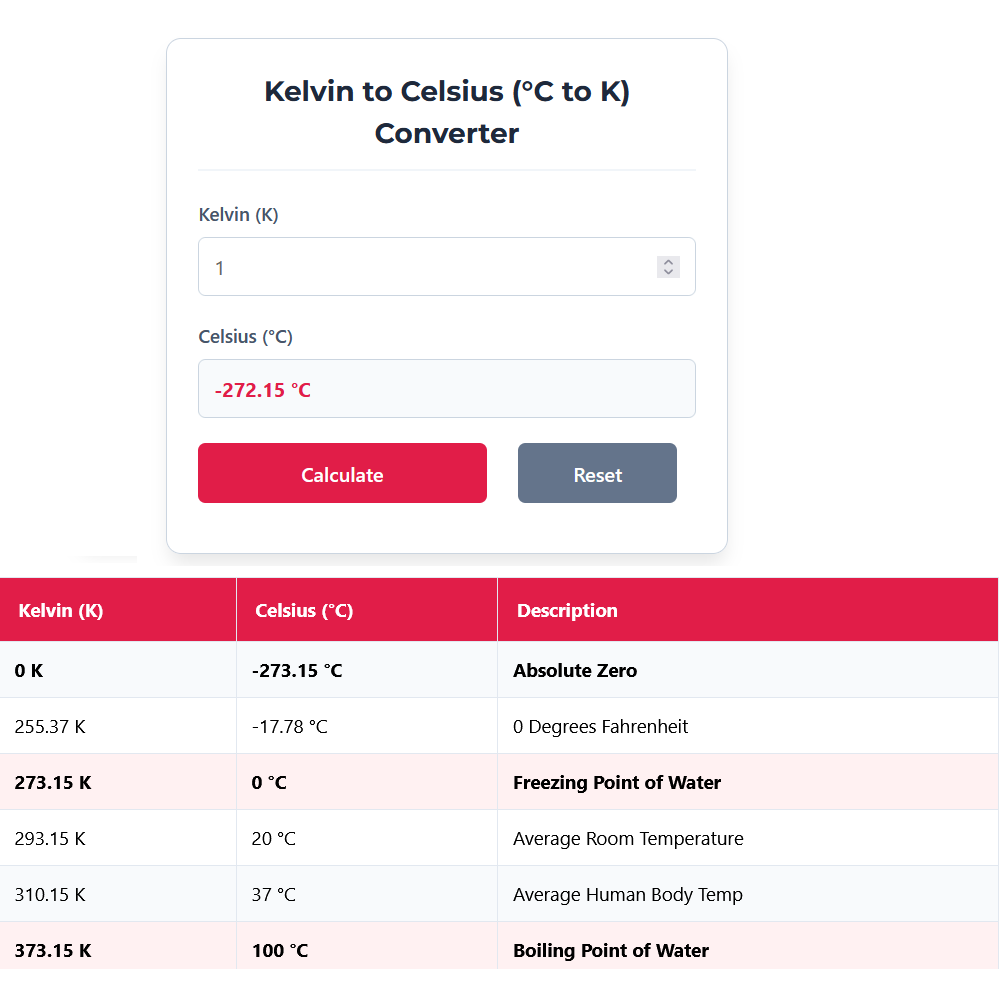
Quick Reference Conversion Table
Here are some of the most common and scientifically significant temperature milestones converted from Kelvin to Celsius.
| Kelvin (K) | Celsius (°C) | Description |
|---|---|---|
| 0 K | -273.15 °C | Absolute Zero |
| 255.37 K | -17.78 °C | 0 Degrees Fahrenheit |
| 273.15 K | 0 °C | Freezing Point of Water |
| 293.15 K | 20 °C | Average Room Temperature |
| 310.15 K | 37 °C | Average Human Body Temp |
| 373.15 K | 100 °C | Boiling Point of Water |
Contextual Information
What is Kelvin (K)?
The Kelvin scale is an absolute thermodynamic temperature scale and is the base unit of temperature in the International System of Units (SI). Because it is an absolute scale, it doesn't use degrees (it is referred to simply as "Kelvins," not "degrees Kelvin"). The scale begins at Absolute Zero (0 K), which is the theoretical point where all thermal motion of particles stops.
What is Celsius (°C)?
The Celsius scale (historically known as centigrade) is an everyday temperature scale based on the properties of water. It sets the freezing point of water at 0 °C and the boiling point at 100 °C (at standard atmospheric pressure). It is the most widely used temperature scale in the world for everyday weather and cooking.
Why is the conversion exactly 273.15?
The Celsius scale was defined long before scientists understood the concept of absolute zero. Once thermodynamics advanced, scientists discovered that absolute zero occurs exactly 273.15 degrees below the freezing point of water. To standardize the two scales, the Kelvin scale was designed so that one Kelvin has exactly the same magnitude as one degree Celsius, leaving a permanent, fixed offset of 273.15 between them.