ACS880 vs. ACS580: The Ultimate ABB Drive Comparison (2026 Guide) – Confused between the ABB ACS580 and ACS880? We break down the critical differences, from Direct Torque Control (DTC) to programming options. Find out if you need the general-purpose workhorse or the high-performance industrial drive.
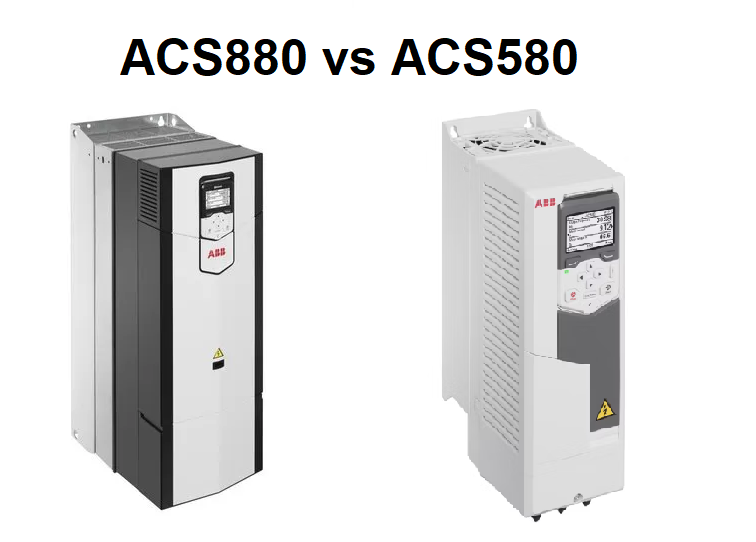
ACS880 VS ACS580: Which ABB Drive Do You Actually Need?
They look identical from the outside. They both share the same keypad. But under the hood, these two drives are built for completely different worlds. Let’s settle the debate.
If I had a dollar for every time a customer asked me, “Why should I pay more for the ACS880 when the ACS580 has the same kilowatt rating?” I’d probably be retired by now.
It’s a fair question. ABB has standardized their “All-Compatible” drives so well that visually, they are hard to tell apart. However, confusing these two can be a costly mistake. Put an ACS580 on a heavy-duty extruder, and it might trip constantly. Put an ACS880 on a simple fan, and you’ve just wasted 30% of your budget on features you’ll never use.
Here is the no-nonsense comparison to help you pick the right tool for the job.
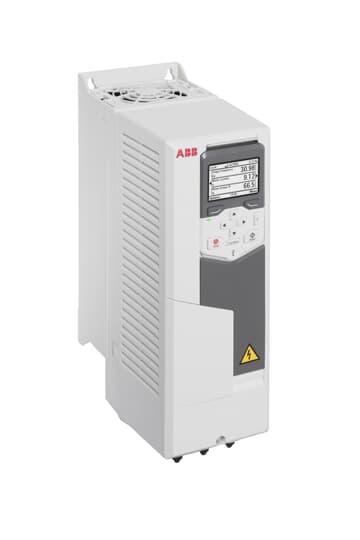
The ABB ACS580: The “Daily Driver”
Think of the ACS580 as the reliable pickup truck. It is designed for General Purpose applications. This drive is built to be installed, set up in 10 minutes, and forgotten about.
Where it shines:
- Simplicity: It uses “Scalar” or “Vector” control. It’s perfect for things that don’t change speed rapidly or require hair-splitting precision.
- All-in-One: It comes standard with the choke (to reduce harmonics) and EMC filters built-in. You don’t need to order extra parts.
- The “Primary Settings” Menu: The software is designed for ease. It asks you questions like “Is this a pump?” rather than asking for obscure parameter codes.
Best For: Centrifugal pumps, fans, compressors, simple conveyors, and mixers. Essentially, variable torque loads.
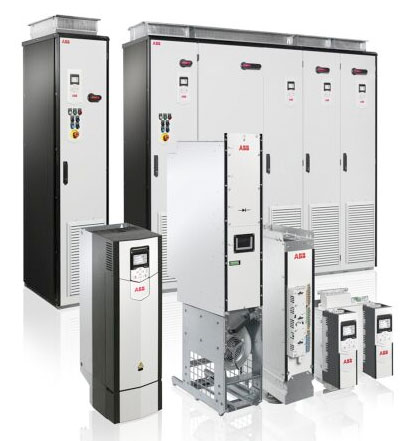
The ABB ACS880: The “Formula 1” Car
The ACS880 is the Industrial Machinery drive. This is for when “good enough” isn’t an option. While it can run a pump just fine, it is engineered for Constant Torque and heavy-duty performance.
The Secret Weapon: DTC
The biggest difference is the control algorithm. The ACS880 uses Direct Torque Control (DTC). Unlike the ACS580, which reacts to the motor, the ACS880 creates a mathematical model of the motor and updates it 40,000 times a second.
This means it can provide full torque at zero speed (holding a load in the air) without an encoder—something the ACS580 simply cannot do.
Key Industrial Features:
- Memory Unit (ZMU): The firmware and parameters are stored on a removable stick. If an ACS880 blows up at 2 AM, you can swap the hardware, plug in the old memory stick, and you are running instantly. No programming required.
- Expandability: It has three option slots (vs. one or two on the 580) for adding extra I/O, encoder modules, or fieldbus communication.
- Master/Follower: You can link drives together via fiber optics for precise load sharing (e.g., on a large conveyor belt).
The Breakdown: Head-to-Head Comparison
| Feature | ACS580 (General Purpose) | ACS880 (Industrial) |
|---|---|---|
| Control Tech | Vector / Scalar Control | Direct Torque Control (DTC) |
| Overload Capacity | 110% (Light Duty) / 150% (Heavy) | 150% standard / up to 200% peak |
| Programming | Adaptive Programming (Basic) | CoDeSys (Full PLC capability) |
| Motor Support | Induction, PM Motors | Induction, PM, SynRM, DD Motors |
| Braking Chopper | Built-in (up to frame R3) | Built-in (up to frame R4) |
The Final Verdict
Choose the ACS580 if: You are moving air or water. If the application involves pumps, fans, or basic material handling where precision isn’t critical, the ACS580 is the most cost-effective and user-friendly choice.
Choose the ACS880 if: You are moving heavy machinery. If you need to hold a load (cranes/hoists), require high starting torque (extruders/crushers), or need the drive to act as a logic controller (PLC), the ACS880 is the only way to go.