What is galvanic isolation and why is it crucial in electronics? Discover how it prevents ground loops, protects equipment, and keeps electrical systems safe.
What is Galvanic Isolation? (And Why Your Electronics Need It)
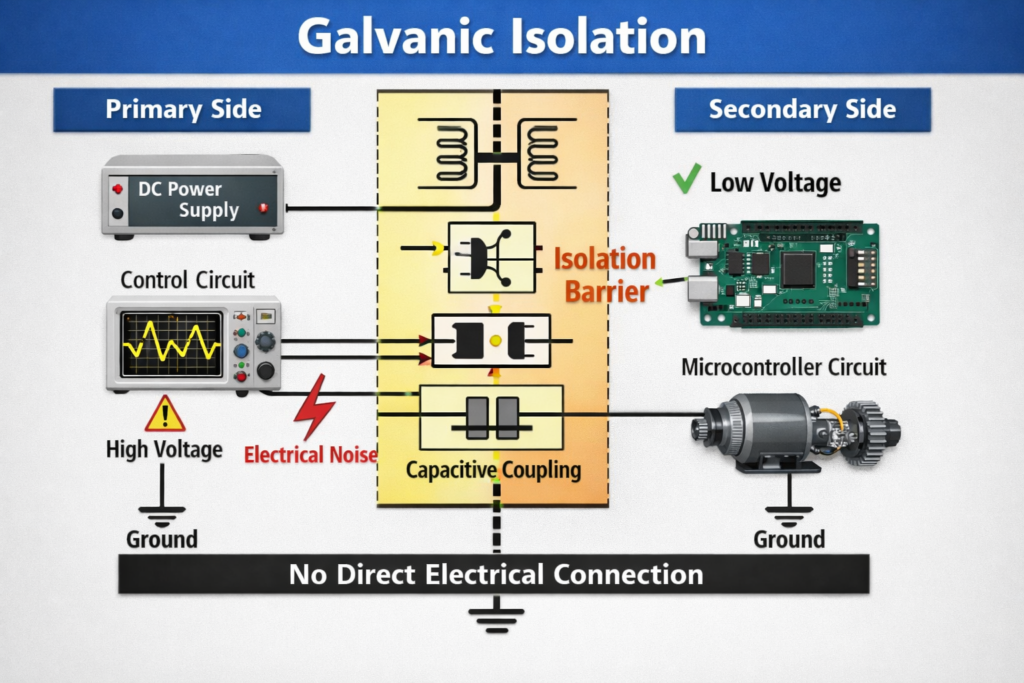
Imagine you have a delicate 5V microcontroller, like an Arduino or a PLC brain, that needs to control a massive 400V industrial motor. If a power surge occurs or a fault happens on the motor side, that 400V spike could instantly travel back down the wire, completely incinerating your low-voltage electronics (and potentially injuring anyone touching it).
So, how do you allow two circuits to “talk” to each other without actually touching? The answer is an engineering marvel known as galvanic isolation.
Whether you are designing medical equipment, troubleshooting industrial automation panels, or trying to fix a buzzing noise in an audio system, galvanic isolation is a concept you must understand. Let’s break down exactly what it is, why we use it, and how it works.
What is Galvanic Isolation?
The term “galvanic” relates to the flow of direct electrical current. “Isolation” means separation. Therefore, galvanic isolation is the practice of separating two electrical circuits so that there is absolutely no direct, physical path for direct current (DC) to flow between them.
Even though the two circuits are physically cut off from one another, they can still exchange information (data signals) or power. They just have to use non-electrical methods—like light, magnetic fields, or electric fields—to bridge the gap.
Why is Galvanic Isolation So Important?
Engineers don’t add isolation to circuits just for fun; it adds cost and complexity. However, it is absolutely essential for three major reasons:
1. Equipment and Human Safety
As mentioned in the introduction, isolation acts as a massive physical firewall. In medical devices like ECG machines, the sensors attached to the patient are galvanically isolated from the wall power. If a catastrophic power surge hits the hospital, the isolation barrier ensures the deadly high voltage cannot reach the patient.
2. Eliminating Ground Loops
If you’ve ever heard a nasty, low-frequency hum in a speaker system, you’ve experienced a ground loop. This happens when two pieces of equipment are connected to different ground points that sit at slightly different voltages. This voltage difference causes unwanted current to flow through the signal cables. By introducing galvanic isolation, you literally break the physical wire connecting the two grounds, instantly stopping the ground loop dead in its tracks.
3. Rejecting Electrical Noise
Industrial environments are incredibly noisy, electrically speaking. Massive motors turning on and off create electromagnetic spikes. Galvanic isolation prevents this heavy industrial “common-mode noise” from creeping into sensitive measuring instruments and scrambling data signals.
How Does Galvanic Isolation Work? (The 3 Main Methods)
If we cut the wire between the two circuits, how do we get the signal across the gap? Engineers generally use one of three brilliant techniques:
1. Optical Isolation (Optocouplers)
This is one of the most common methods for isolating digital signals. An optocoupler (or optoisolator) is a small microchip containing two things: a tiny LED light and a photo-receptor.
When Circuit A wants to send a signal, it flashes the LED. On the other side of a microscopic physical gap, the photo-receptor in Circuit B “sees” the light and converts it back into an electrical signal. Because light bridges the gap, no electrical voltage can cross!
2. Magnetic Isolation (Transformers)
This is the oldest and most robust form of isolation, relying on electromagnetic induction. Inside a transformer, there are two coils of wire wrapped around a magnetic core. They do not touch.
When alternating current (AC) flows through the first coil, it creates a magnetic field. This magnetic field reaches across the physical gap and induces a matching voltage in the second coil. Transformers are entirely galvanically isolated, making them perfect for transferring heavy raw power as well as high-speed data.
3. Capacitive Isolation
Capacitive isolators use a rapidly changing electric field to transmit data across a dielectric (insulating) barrier. While they are not used for transferring high power, they are incredibly fast and take up very little space on a circuit board. They are heavily used in modern, high-speed digital communications where optocouplers might be too slow.
Where Will You Find Galvanic Isolation?
Because it is the ultimate problem-solver for safety and noise, you will find galvanic isolation everywhere in modern technology:
- Industrial Automation: Between PLCs (Programmable Logic Controllers) and field sensors.
- Electric Vehicles (EVs): Isolating the massive 400V/800V battery packs from the 12V dashboard electronics.
- Power Supplies: Every standard laptop charger uses a high-frequency transformer to isolate the 120V/240V wall power from your laptop’s sensitive motherboard.
- Audio Engineering: DI (Direct Injection) boxes use isolation transformers to remove ground hum from instruments.
Wrapping Up
To summarize, galvanic isolation is the invisible shield of the electronics world. By using light, magnetism, or electric fields to jump a physical gap, it allows systems to communicate while blocking ground loops, electrical noise, and deadly voltage spikes.